
Market Recap: September 2026

October 02, 2026

Market commentary
- The ongoing U.S.–Iran conflict kept oil prices high, pushing national gasoline prices above $4.50 a gallon and raising diesel and jet fuel costs that ripple through the economy, from airfares to groceries.
- The Fed raised its key interest rate in September, joining Japan and Europe, and Fed funds futures are currently pricing in nearly 100 basis points of rate hikes over the next 12 months.
- Employers added 162,000 jobs in August and unemployment held at 4.1%, as companies remain slow to hire but rarely lay workers off.
- Consumers continue spending, helped by stock market gains, tax refunds, and a lower savings rate, even as confidence remains weak.
Select economic and market data
Statistic (monthly unless noted) |
Current |
Previous |
|---|---|---|
| U.S. GDP (quarterly) | 2.2% | 2.5% |
| Consumer Confidence | 81.9 | 88.6 |
| Consumer Price Index Y/Y | 3.4% | 3.4% |
| Core PCE (x food & energy) | 3.0% | 3.0% |
| ISM Manufacturing Index | 54.5 | 54.6 |
| Unemployment Rate | 4.1% | 4.1% |
| 2-Year Treasury Yield | 4.89% | 4.34% |
| 10-Year Treasury Yield | 5.29% | 4.75% |
Equities
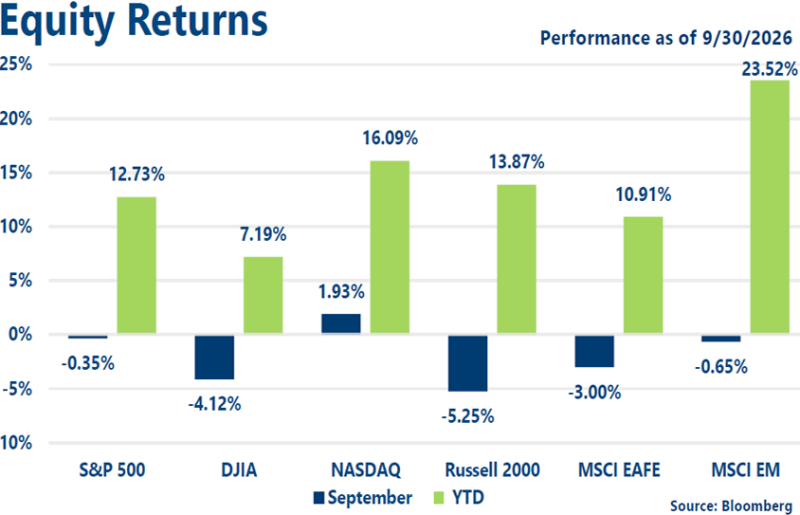
- Technology and communication services stocks led in September, while materials, financials, and smaller companies fell the most. For the year, energy remains the market’s strongest group, while consumer-focused stocks have struggled as worries about inflation, AI-driven job losses, and geopolitics weigh on consumer confidence.
Fixed income
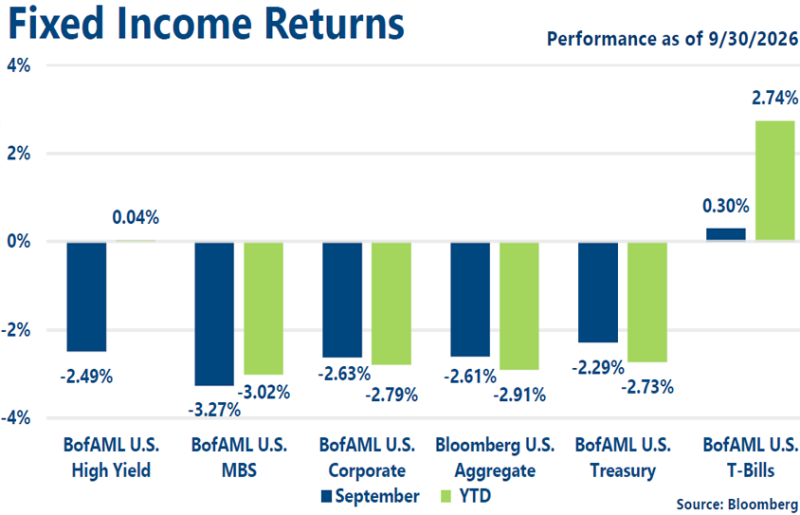
- Long-term interest rates climbed to their highest levels since before the 2008 financial crisis, pushing bond prices lower and weighing on rate-sensitive stocks like utilities and real estate. Higher rates are also making mortgages more expensive, which keeps homeowners with low locked-in rates from moving and leaves home sales and new construction sluggish.
Strategic outlook
- Stronger economic growth and earnings remain supportive of equities despite elevated valuations.
- Higher yields have improved forward return expectations and income potential for fixed income investors.
- Equity and fixed income volatility may remain elevated as investors balance growth, inflation, and policy and geopolitical risks.



|
Learning Center articles, guides, blogs, podcasts, and videos are for informational purposes only and are not an advertisement for a product or service. The accuracy and completeness is not guaranteed and does not constitute legal or tax advice. Please consult with your own tax, legal, and financial advisors.
