
Market Recap: August 2026

September 02, 2026

Market commentary
- The economic backdrop remains consistent with a slow-growth, soft-landing scenario. Although recession risks are lower than they were a year ago, persistent inflationary pressures, widening fiscal deficits, and elevated interest rates continue to pose challenges to the outlook.
- Manufacturing activity and AI-driven capital investment remain bright spots, helping to offset weakness in the housing market and consumer-facing sectors.
- Consumer spending continues to support economic activity but is showing signs of moderation as households contend with weak confidence, higher interest rates, and rising energy costs.
- Housing remains the weakest major sector, as elevated rates continue to weigh on affordability, home sales, and new construction activity.
Select economic and market data
Statistic (monthly unless noted) |
Current |
Previous |
|---|---|---|
| U.S. GDP (quarterly) | 1.5% | 2.1% |
| Consumer Confidence | 89.4 | 90.2 |
| Consumer Price Index Y/Y | 3.4% | 3.5% |
| Core PCE (x food & energy) | 3.3% | 3.3% |
| ISM Manufacturing Index | 55.8 | 55.6 |
| Unemployment Rate | 4.1% | 4.2% |
| 2-Year Treasury Yield | 4.34% | 4.29% |
| 10-Year Treasury Yield | 4.75% | 4.74% |
Equities
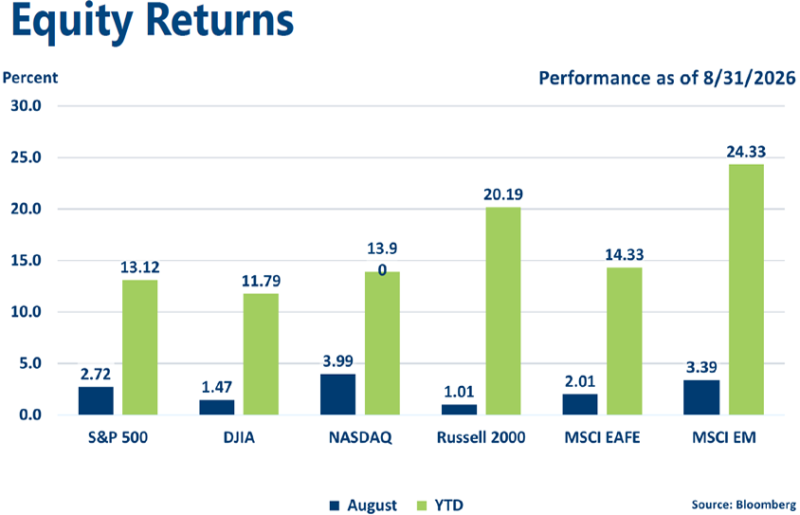
- The S&P 500 gained 2.72% after back-to-back monthly declines, with strength extending across most major equity markets both in the U.S. and abroad.
- Expectations for sustained higher oil prices amid ongoing Iran-related uncertainty helped Energy outperform in August, while Technology, Materials, and Healthcare also advanced.
Fixed income
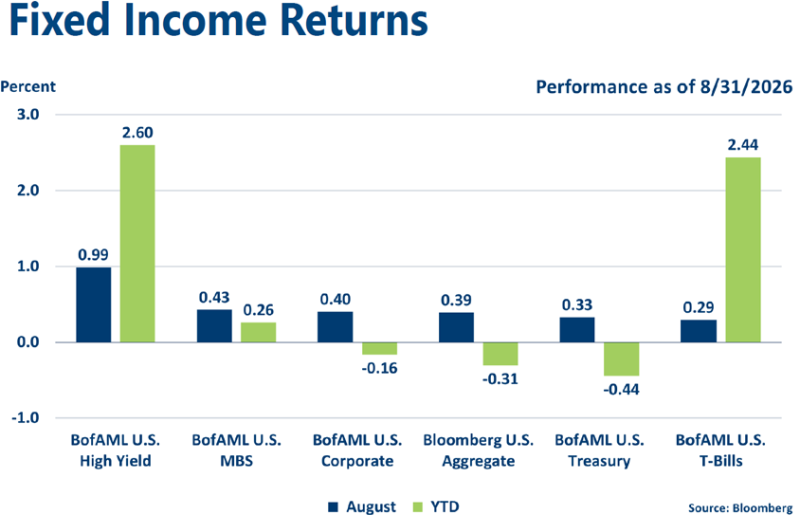
- Treasury supply and fiscal concerns remained key market drivers, as persistent federal deficits and ongoing Treasury issuance continued to place upward pressure on bond yields.
Strategic outlook
- Near-term caution toward equities is advisable, given heightened risks from geopolitical instability, trade uncertainty, and the potential for renewed inflationary pressures alongside an economic slowdown.
- Near-average expected returns projected for fixed income with the Fed on pause and rates reflective of economic conditions.
- Above-average volatility is likely given central bank involvement and geopolitical uncertainty.



|
Learning Center articles, guides, blogs, podcasts, and videos are for informational purposes only and are not an advertisement for a product or service. The accuracy and completeness is not guaranteed and does not constitute legal or tax advice. Please consult with your own tax, legal, and financial advisors.
